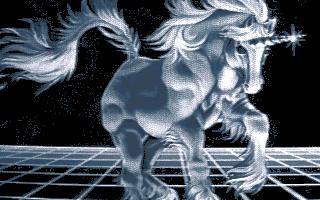
The Real Story on Unicorns
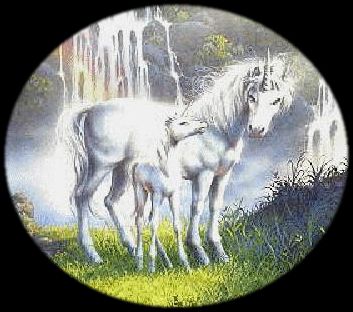
The Real Story on Unicorns
Unicorn. Equus
uniceros. Capra uniceros.
There are actually two varieties
of unicorn, the horse (E. uniceros) and the goat (C. uniceros), but this
story is of the white horse with the magical horn.
"...After the great battle
between the Tuatha De Danann and the fierce Firbolgs, the Goddess
Herself appeared among the remnants of Her victorious people. She
wandered among the mortals, giving blessings to those who lay dying and
the gift of Her healing touch to those who could be saved. During
the course of Her wandering, She happened upon a great white horse.
The poor beast stood on splayed legs, sides heaving mightily, and nose
almost touching the ground. Blessing him with speech, she asked gently,
'Are you wounded?' 'Nae, Mistress, I am not wounded.'
'Then why do you stand there in such low spirit?' She asked the beast.
The horse answered in a weary voice saying, 'Goddess Danu, I am called
a war-horse. It is true that I use my hooves and teeth during battle
to help my master, but they are weak weapons. I have allowed my master
to be killed. I am shamed.' The Goddess took pity on the war-horse
and taking his head gently between Her hands, She placed a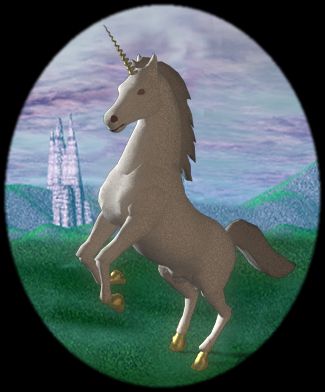 kiss upon his forehead. To the amazement of the beast and those mortals
around him, an ivory horn sprung from the spot upon which the kiss had
been placed. Immediately, the great horse sank to his knees and thanked
Danu for Her gift. 'I will call you Unicorn, She told the animal.
Now go and learn to use your new weapon.' Unicorn turned and trotted
gaily from the scene of the battle, swinging his head, brandishing the
gleaming horn. He happened upon some young warriors who had not been
in the battle and they agreed to teach him swordplay. To the horror
of the great Unicorn, and the mortal souls around him, he miscalculated
his thrust at the first young warrior and gored the youth through the heart.
With a scream of shame and anguish, the beast galloped from the scene and
was never seen no more."
kiss upon his forehead. To the amazement of the beast and those mortals
around him, an ivory horn sprung from the spot upon which the kiss had
been placed. Immediately, the great horse sank to his knees and thanked
Danu for Her gift. 'I will call you Unicorn, She told the animal.
Now go and learn to use your new weapon.' Unicorn turned and trotted
gaily from the scene of the battle, swinging his head, brandishing the
gleaming horn. He happened upon some young warriors who had not been
in the battle and they agreed to teach him swordplay. To the horror
of the great Unicorn, and the mortal souls around him, he miscalculated
his thrust at the first young warrior and gored the youth through the heart.
With a scream of shame and anguish, the beast galloped from the scene and
was never seen no more."
This is the only account I have
found of this incident, but it is taken from a book which has been well
documented. Knowing no reason, why such a tale would be invented
and included in a history, I set out to research this beast. These
are my findings:
Unicorn wandered alone through
the wilds of Eire for a full year, mourning the loss of his master and
and the murder of the young, unnamed warrior. After a time the Goddess,
sensing his misery, visited Her magical stable and chose the best filly
of Her stock. As with Unicorn, She blessed Uniceras with the gift
of speech, and placed the kiss upon her forehead. She sent Uniceras
to find Unicorn and keep him company.
Unicorn was gladdened by the presence
of the filly and soon forgot his misery. But being aware of the dangers
of the weapons upon their foreheads, he exacted a promise from Uniceras
that she would never again seek the company of humans.
There are many tales of scant
glimpses of unicorns throughout history. These unicorns are the descendants
of Unicorn and Uniceras. Most of the tales were brought to England
by travelers and the unicorn became a mythical legend along with the tales
of the De Danann faerie folk. Note that the English, rather than
the Irish, were the people who made the unicorn famous. They searched
for the unicorn relentlessly because they believed the horn to be magical
with healing powers. They haunted the beasts and slaughtered them
unmercifully. Because of Uniceras' promise and this great slaughter,
the unicorn has become the most secretive animal on Earth. Sorrowfully,
the horn is only useful to a living unicorn and its only magic is in its
first creation.
The male and female unicorns are
usually of the same size. The overall appearance is that of a dainty
horse, Arabic in proportion and size. The mane and tail are extremely
long and silken and tufts of this mane hair grow from the chin and the
hock.
The foals are born almost helpless
and cannot stand or walk for several days. It is believed that this
is reverse "survival of the fittest" in that the foals which are adventurous
and strong are more easily captured by humans. They are born with
a mottled dun coat which helps to hide them in the forests and mountains
they call home. The coat gradually lightens to become the brilliant
white of the adult. Immature unicorns stay with their sire and dam
for a period of about 7 - 8 years, learning to  survive
in a world which names them legend.
survive
in a world which names them legend.
The horn begins to sprout at about
four years and takes about three years to develop into a powerful weapon.
In olden times, the horn was used to fight off bears, lions, and wolves.
Being that those animals are now extinct in Ireland, the unicorn has no
need of battle skills except when threatened by humans.
Unicorns are not herd animals
like their cousins the horses, but live in family groups of three.
The sires teach the young ones about Uniceras' promise and the stealth
they need to stay hidden. The mares provide the care and grooming.
When two family groups meet, they may travel together for a day or two,
but generally they tend to stay separate. A small family group is
harder to spot than a herd of six.
The animals have been known to
graze with domestic horses, keeping their heads low to hide their horns
and chin hair. These days it is much harder for them to be inconspicuous
because farmers know their own animals and do not welcome strays.
When the young unicorn reaches
maturity, it leaves its parents and begins a solitary life which lasts
about ten years. Very little is known of the reason for this sojourn,
but it rumored to be a sort of homage to the Goddess Danu, a time in which
the young animal learns of its own inner strengths. It is during
this period that most unicorns are seen by humans. Many stories have
been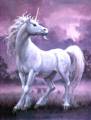 told of captured
unicorns promising to lead its captor to gold if it is released.
But the freed unicorn is a swift and intelligent animal and can quickly
"disappear" from sight.
told of captured
unicorns promising to lead its captor to gold if it is released.
But the freed unicorn is a swift and intelligent animal and can quickly
"disappear" from sight.
After the solitude, the now mature
animal seeks out a mate. The gestation period lasts from 30 to 32
months. When a mare finally gives birth, she is generally about 20
years old. The mated pair raises only one or two foals during their
lives which is why the beasts are so rare.
After the last offspring leaves the parents, the two generally live out the remainder of their lives without the company of others. When elderly unicorns feel that Death is near, they travel to the northern sea. Once there, they embed their horns in rock to snap them off, then leap into the sea further protecting the secret of their existence.
The most recent capture of a unicorn happened in the early 19th century. A young English lad visiting the mountains somehow managed to come between a young animal and the mouth of the gully in which it had bedded. The youth quickly lassoed the beast in the manner of American cowboys and was amazed when the animal spoke to him in the ancient Gaelic tongue. Not understanding the language, the young man called out for his companions. While his attention was diverted, the beast used its horn to cut through the rope, leaped over the lad, dodged the companions and escaped. No verifiable sighting of a unicorn has been reported since.
I hope this essay satisfies your
curiosity. I have given my word that I would never divulge my source.
The unicorn wishes to be left to itself to worship the Goddess and raise
its young. Sadly, there are few of them left in Ireland with little
room to roam. With the mistrust and ill feelings between unicorn
and human kind, they have had no opportunity to cross the seas to other
places.
Remember, if you ever see a unicorn,
delight in the sight, but leave him to his peace.
Domestic horse. E. caballus
Domestic goat. C. hircus